Find out what you have
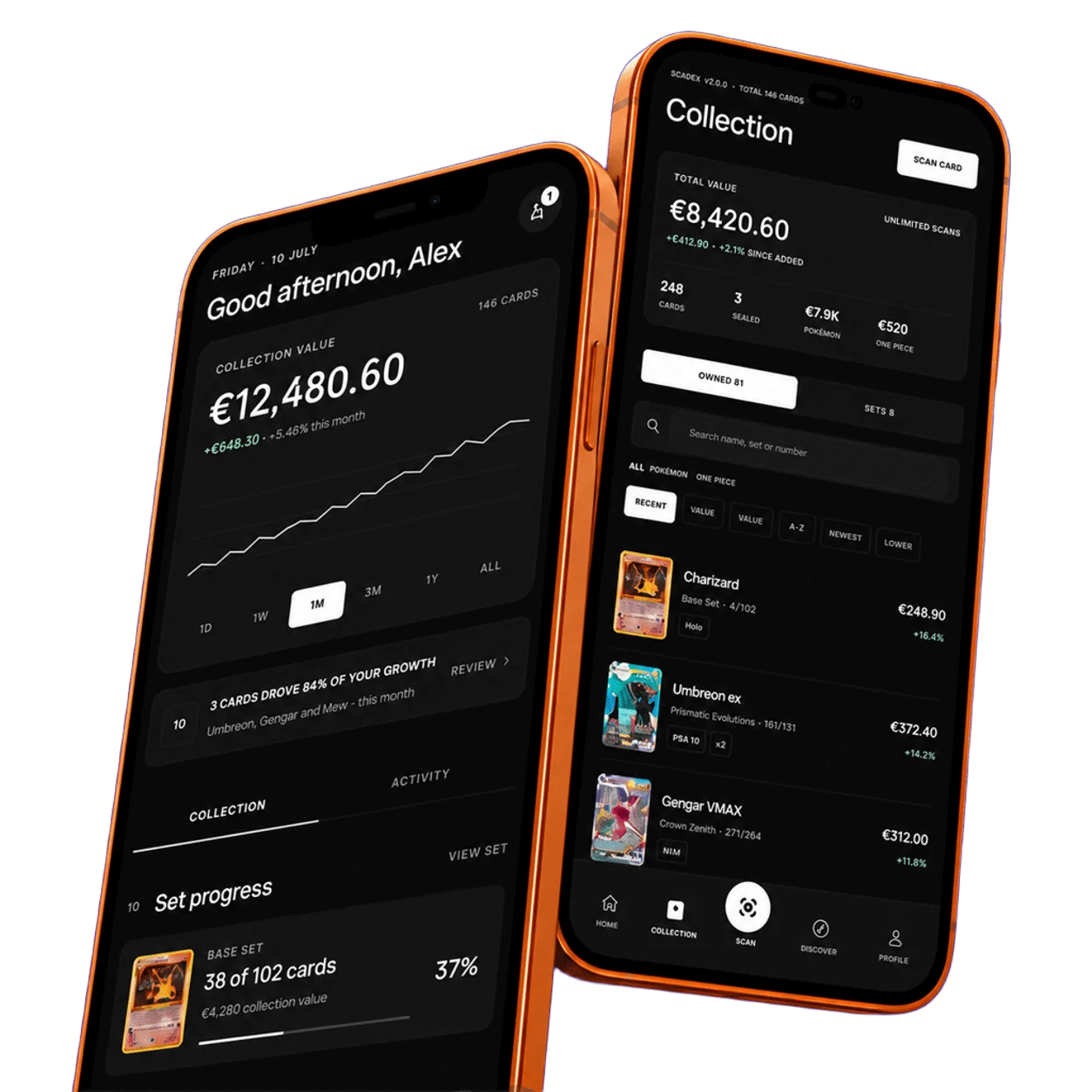
Scan the collection so you have a list with prices attached. Selling from memory is how the good cards end up in the bulk box.
 Get Scadex
Selling
Three routes out of a collection, each with a different exchange rate between your time and your money. Picking the wrong one is how people end up either underpaid or still listing cards eight months later.
Published August 2026
Almost every mistake in selling cards comes from mixing the routes up: listing five-cent commons individually, or handing a shop a box with three cards in it worth more than the rest combined. Sort that out first and the rest is mechanical.
| Route | Your effort | What you get | How fast |
|---|---|---|---|
| Marketplace singles | High — list, pack and post each sale | Closest to market price | Weeks to months |
| Bulk to a shop or buyer | Low — one handover | Well below market, by design | Same day |
| Local sale or convention | Medium — travel and haggling | Between the two, no postage | One afternoon |
The shop route is not a rip-off, incidentally. A shop is buying the work of sorting, storing and eventually selling several thousand cards, most of which will never sell. The discount is what that work costs.
The order to do it in
The first one is the one people skip, and it is the one that decides whether the rest is worth doing.
Scan the collection so you have a list with prices attached. Selling from memory is how the good cards end up in the bulk box.
Decide the value below which a card is bulk. Anything under it goes in the box; anything above it gets listed properly.
Use European market prices in euros for the exact printing and condition, not a converted US figure for the card in general.
Sleeve, rigid protection, plain outer packaging, tracked postage above a certain value. Every refund starts here.
The total your collection shows is a market total, not what will land in your account. Four things sit between the two, and none of them is optional.
How much is my collection worth? works through the difference between the market total, what you would net selling it, and what it would cost to replace — three numbers that are routinely confused with each other.
The headline market figure is a starting point, not an instruction. Two things decide whether your listing moves: where you sit relative to the other copies for sale, and whether anyone is buying that card at all right now.
If thirty copies are listed and yours is the twenty-ninth cheapest, the price is not the problem, the queue is. If a card has not sold in two months, the listings are asking prices with nobody behind them, and matching them means joining a queue rather than making a sale. Sale frequency matters more than the headline number, which is why it is worth looking at how often a card actually changes hands before you set your price.
Then be accurate about condition. Grade honestly against a scale rather than optimistically against your own card — the condition guide covers the European ladder and what each step means. A card described as Near Mint that arrives Excellent costs you the return postage, the fee and the rating.
Bulk sells by the hundred or the thousand, priced per card at a level that only makes sense in volume. Two things follow. First, sort it before you offer it: separated by game, and with holos and higher rarities pulled out, bulk is worth meaningfully more than an unsorted heap. Second, weigh it before you promise to post it, because a thousand cards is heavier than people expect and the postage can eat the entire sale.
For bulk specifically, local beats postal almost every time. A shop, a local buyer or a convention table avoids the shipping problem entirely.
A single card goes in a sleeve, then something rigid — a toploader or a semi-rigid holder — then between two pieces of card so it cannot bend, then in a plain envelope or a small board-backed mailer. Cheap, quick, and it prevents the two things that actually go wrong in transit: bending and moisture.
Above a certain value, use tracked postage and keep the proof. Where that line falls depends on how much you are willing to lose to a claim you cannot evidence; for most people it is somewhere around the point where the tracking costs less than the risk. For anything genuinely valuable, insured postage and a photograph of the packed card before it goes out are worth the few minutes.
Plain packaging, incidentally. An envelope printed with a card shop’s logo advertises what is inside it, and the whole route from your table to the buyer’s door is not staffed by collectors.
Slabs are bought by a different buyer, sold on the strength of the grade rather than your description of it, and shipped as a small hard object rather than a flat one — bubble wrap in a box, not an envelope. If you are still deciding whether to send something for grading before selling it, the break-even maths is the thing to read first, and grading from Europe covers the postage and customs that make the European answer different.
Common questions
It depends on what you are selling. Individual cards worth more than a few euros do best on a European marketplace, where you get closest to market price at the cost of listing and posting each one. Bulk does best sold locally to a shop, a buyer or at a convention, because postage on a thousand cards can cost more than the cards. Mid-value cards are the judgement call, and the deciding factor is usually how much of your own time you are willing to spend.
Less than the market total, and the gap is bigger than most people expect. Marketplace commission and payment fees take a percentage, postage takes a fixed amount per sale that hurts most on cheap cards, condition below the quoted grade takes another cut, and bulk sells for a small fraction of its listed value. As a rough mental model, treat the market total as a ceiling you will not reach rather than a figure you are owed.
Both, in the same collection. Cards above a threshold you set yourself are worth listing individually; everything below it is bulk and should be sold as a lot. The mistake to avoid is dumping the whole collection as one lot without checking it first, because the buyer will check it, and the few cards carrying the value are exactly the ones they are counting on you not knowing about.
That depends on your country and on whether you are clearing out a personal collection or trading regularly, and the two are treated very differently in most European tax systems. Marketplaces in the EU also report seller data above certain thresholds. We cannot give you an answer that is correct in every country, so check your national rules if you are selling at volume.
Sleeve it, put it in a toploader or semi-rigid holder, sandwich that between two pieces of stiff card, and send it in a plain envelope or board-backed mailer. Use tracked postage above the value you would be unhappy to lose, keep the proof of postage, and photograph the packed card before it goes out. Plain packaging matters: nothing on the outside should suggest what is inside.
Keep reading
Market total, net proceeds and replacement cost, kept apart.
Read the guide →Worth knowing from the buying side too, before money changes hands.
Read the post →The cards you are not selling yet, kept in the condition you would want to sell them in.
Read the post →Your collection starts here