Put a real one beside it
A known-genuine card from the same set is the single most useful tool you own. Differences you would never notice alone are obvious side by side.
 Get Scadex
Buying safely
Counterfeits get better every year, and they still fail the same short list of checks. Here is the list, roughly in the order of how little effort each one costs you.
Published August 2026
The cheap checks
Before anything technical, these four catch the large majority of counterfeits in circulation.
A known-genuine card from the same set is the single most useful tool you own. Differences you would never notice alone are obvious side by side.
Not the card name — the small print. Set symbol, card number, rarity mark, the copyright line along the bottom edge.
Look at how the gloss moves across the surface, and whether the holographic pattern reacts the way the genuine card next to it does.
Run a thumb around the border. Genuine cards are cut cleanly; fakes are often slightly rough, thicker, or unevenly trimmed.
Counterfeiters reproduce the picture well, because the picture is the part they can copy from a high-resolution scan. What they reproduce badly is everything printed at six point: the copyright line, the illustrator credit, the set symbol, the card number and the rarity mark.
So read those first. Look for text that is slightly too bold or too thin, letters spaced a fraction too wide, a symbol that is the right shape but the wrong weight, or a card number in a format that set never used. Misspellings still turn up, and they are conclusive — but the more common tell is not a spelling error, it is text that is faintly blurred where the genuine card is razor sharp.
This is also where a phone camera earns its keep. Photograph the bottom edge of both cards at maximum zoom and compare them on screen. Print that looks acceptable to the naked eye often falls apart at 5×.
Fakes tend to miss in one of two directions: colours pushed too saturated, so the card looks unusually vivid, or flattened and slightly grey, as though photocopied. Against a genuine card from the same set the difference is usually immediate. On its own, it is easy to talk yourself out of.
Gloss is harder to fake than colour. Tilt the card under a lamp and watch the reflection travel across it. Holographic and foil patterns should move and break up in the same way as the real card beside it, not shimmer uniformly like a sticker. Where the genuine version of a card has a raised texture — many modern special rares do — a smooth surface is a serious problem, because texture requires tooling that most counterfeit operations do not have.
Pokémon cards are made as a sandwich, with a thin dark layer between the front and back faces. That layer is why you cannot read the front of a card by shining a torch through the back of it. Hold a genuine card against a bright light and very little passes through. Hold up a fake with no core layer, and the artwork often glows visibly through the card.
This is a good test, not a perfect one. Better counterfeits include a dark layer specifically to survive it, and some genuine cards from other games are built differently, so calibrate against a real card of the same game and era rather than against your expectations.
| What you check | Genuine tends to look | Worth a second look |
|---|---|---|
| Small print | Sharp at high zoom, consistent weight | Slightly blurred, too bold, too thin, odd spacing |
| Colour | Matches other cards from the set | Unusually vivid, or flat and greyish |
| Gloss and foil | Pattern breaks up as you tilt it | Uniform shimmer, or no reaction at all |
| Texture | Raised where the set uses texture | Smooth where it should be textured |
| Edges | Clean cut, consistent thickness | Rough, fuzzy, thicker or thinner than usual |
| Back face | Colour and pattern match exactly | Different blue, off-centre pattern |
| Light through it | Almost none | Artwork visible from the other side |
With sealed packs and boxes you are not judging a card, you are judging a wrapper — and the failure mode is usually not a counterfeit box but a genuine one that has been opened, searched and resealed. Weight is the usual tell for a resealed pack, which means it is only useful if you have several from the same product to compare.
The practical answer is to be much more careful about where sealed product comes from than about the product itself. Buy from shops and sellers with a long record, be sceptical of loose packs sold individually well below the going rate, and treat anything advertised as a “guaranteed hit” as exactly what it sounds like.
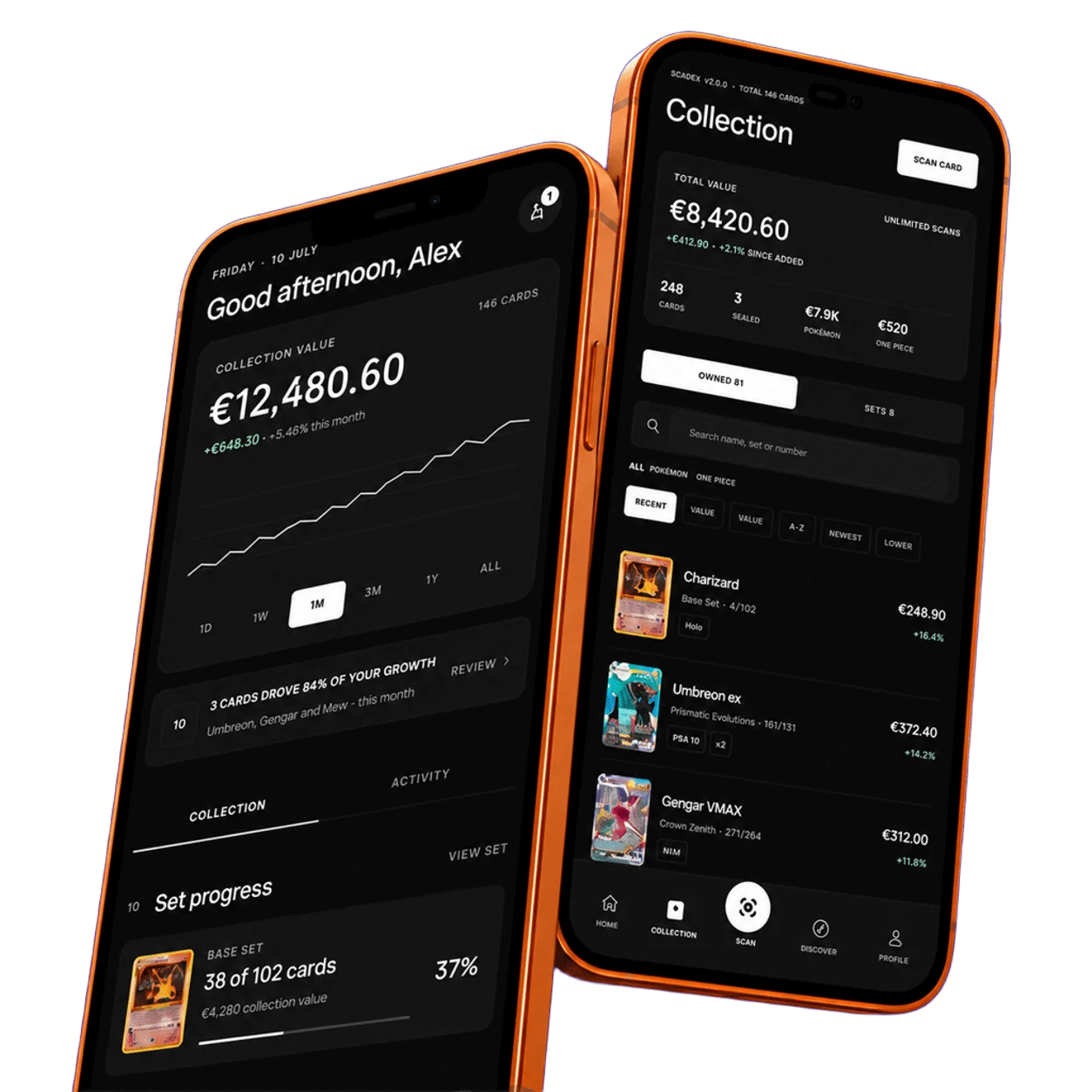
Worth being direct about this, since you are reading it on the site of a scanning app: Scadex is not a counterfeit detector, and neither is any other card scanner. It identifies which card an image depicts and what that card trades for. It does not certify that the piece of card in your hand is genuine.
What it does give you is context, and two kinds of it are useful here. If a scan cannot match a card to any known printing, or returns a set and number combination that does not line up with what is printed on the card, something is wrong — possibly the scan, possibly the card. And knowing the real market price tells you whether the asking price makes sense at all.
That second one catches more fakes than any physical test, because counterfeits are usually priced to move. A card listed at a fraction of what it consistently sells for in Europe is telling you something before you have looked at it. How Scadex prices cards covers where those figures come from and how much weight to put on them.
Do not send it back before you have documented it. Photograph the card, the packaging and the listing, then open a case with the marketplace rather than settling it privately with the seller — private refunds leave no record and the same cards get relisted the following week. Buyer protection on the established European marketplaces is the reason to use them instead of a payment link in a chat.
And report it. A seller who is shifting counterfeits is not doing it once, and platforms act on patterns rather than single complaints.
Common questions
Compare it against a card you know is genuine from the same set. Check the small print at high zoom for blurred or oddly weighted text, look at how gloss and foil react as you tilt the card, feel the edges for a rough cut, and hold it to a bright light — genuine Pokémon cards have a dark core layer that blocks almost all of it. No single check is conclusive, but a card that fails several is not one to buy.
No. Scadex and other scanner apps identify which card an image depicts and what it trades for; they do not verify that the physical card is genuine. What they do help with is price context, and a listing far below the real European market price for that card is one of the strongest warning signs there is.
It is a good first test rather than a definitive one. Genuine Pokémon cards include a dark layer between the front and back faces, so very little light passes through. Better counterfeits now include a dark layer to pass this test, and other card games are built differently, so always compare against a real card of the same game and era.
Rarely one at a time, but often in bulk. Large mixed lots sold by weight or by the hundred sometimes contain counterfeit commons, because nobody checks a common. If you buy bulk to fill a set, spot-check a handful of cards from different parts of the lot rather than assuming the cheap cards are safe.
Photograph the card, the packaging and the listing before returning anything, then raise it with the marketplace rather than arranging a private refund. A platform case creates a record that can be acted on, and it is the reason to buy through an established European marketplace rather than through a direct payment link.
Keep reading
Where to sell, what the fees really cost, and how to price to actually sell.
Read the post →Once you know it is real, this is how to judge what shape it is in.
Read the guide →Where European market figures come from, and what they do not tell you.
Pricing methodology →Your collection starts here