
Grading guide
Grading cards from Europe.
Almost everything written about grading assumes you are posting a card within the United States. From Europe the fee is often the smallest part of the bill.


Updated August 2026
Why the advice you have read does not apply
The grading conversation online is overwhelmingly American. In that context the decision is roughly fee plus domestic postage against the slab premium, and turnaround is measured against a domestic queue. Send from Rotterdam, Munich or Warsaw and three things change at once: the postage is international, the return leg is an import, and you are exposed to a currency you do not price in.
None of that makes grading a bad idea from Europe. It does mean the break-even is meaningfully higher than the figure a US guide will give you, so a card that is marginal there is often a clear no here.
The costs European senders forget
VAT and duty on the return leg
This is the big one. If your card leaves the EU customs area and comes back, the return shipment can be treated as an import, with VAT and potentially duty assessed on a value that may include the card itself rather than only the service performed on it. On a valuable card that is a substantial number.
Customs procedures exist for goods that leave temporarily and return after processing, and used properly they are designed to avoid exactly this outcome. The catch is that they depend on the export being declared correctly before the card goes, not corrected afterwards, and the practical detail varies by member state. Treat this as something to establish in advance with your national customs authority or a customs agent — the cost of getting it wrong is far higher than the cost of asking.
Insured international postage, twice
Insuring a valuable card across a border in both directions is not the same expense as a domestic tracked envelope. Get the actual quote for the declared value you need rather than assuming, because for mid-value cards it can rival the grading fee.
Currency risk
If you pay a fee in dollars and sell in euros, the rate can move against you across a multi-month turnaround. It is rarely decisive but it is real, and it always cuts the same way as the other surprises.
The bulk threshold problem
Per-card economics improve with volume, since shipping and customs handling are largely fixed per shipment. That pushes European collectors toward submitting in batches, which in turn means more capital and more cards sitting in a queue at once.
How to compare graders from here
Reputation rankings are the least useful way to choose. These are the axes that actually change the outcome for a European sender.
- Where the cards are physically graded. This determines whether a customs border is involved at all, and it is the single biggest lever on total cost. Some companies have operated European facilities or intake points; whether that is true today, and for your country, is worth confirming directly.
- Whether there is a local intake route. An authorised dealer or collection centre in your region can consolidate submissions, which spreads shipping and handling across many cards and takes the customs paperwork off your desk.
- How the grade is expressed. A single overall number and a set of sub-grades are different products. Sub-grades give buyers more to scrutinise, which helps a strong card and hurts a borderline one.
- What buyers in your market actually pay. This is the one to research per card rather than in general, and it is covered below.
- Turnaround, including the shipping legs. Advertised turnaround usually starts when the grader receives the card. Add both postage legs and any customs delay to get the number that matters to you.
Which slab sells best is a per-card question
People want a ranking, and there isn't a stable one. Relative premiums differ by game, by era, and by grade, and they shift as buyer preferences move. A company that commands a premium on vintage Pokémon may not on modern One Piece.
The reliable method is unglamorous: find completed sales for your exact card, in each company's slab, at the same grade, priced in euros. If you cannot find European sales of a given company's slab for that card, that absence is itself the answer — a slab nobody in your market is buying is not liquid, whatever the company's reputation.
The case for grading inside Europe
Europe-based grading companies avoid the customs problem entirely, and typically cost less and return faster. The trade-off is recognition: the largest international companies have the broadest buyer trust, and a slab from a smaller grader can be harder to sell or fetch less even at the same stated grade.
Which way that trade-off falls depends on why you are grading. Grading to sell means liquidity matters most, and the widely recognised companies usually win despite the cost. Grading to protect and authenticate a card you intend to keep changes the calculation substantially, because you are buying a case and a verdict rather than an exit.
Before you send anything
Run the numbers on the specific card first. Our worth-grading guide covers the break-even method, including the trap of pricing your decision at a grade you are unlikely to receive. Then add the European costs above to the total, and check whether the case survives.
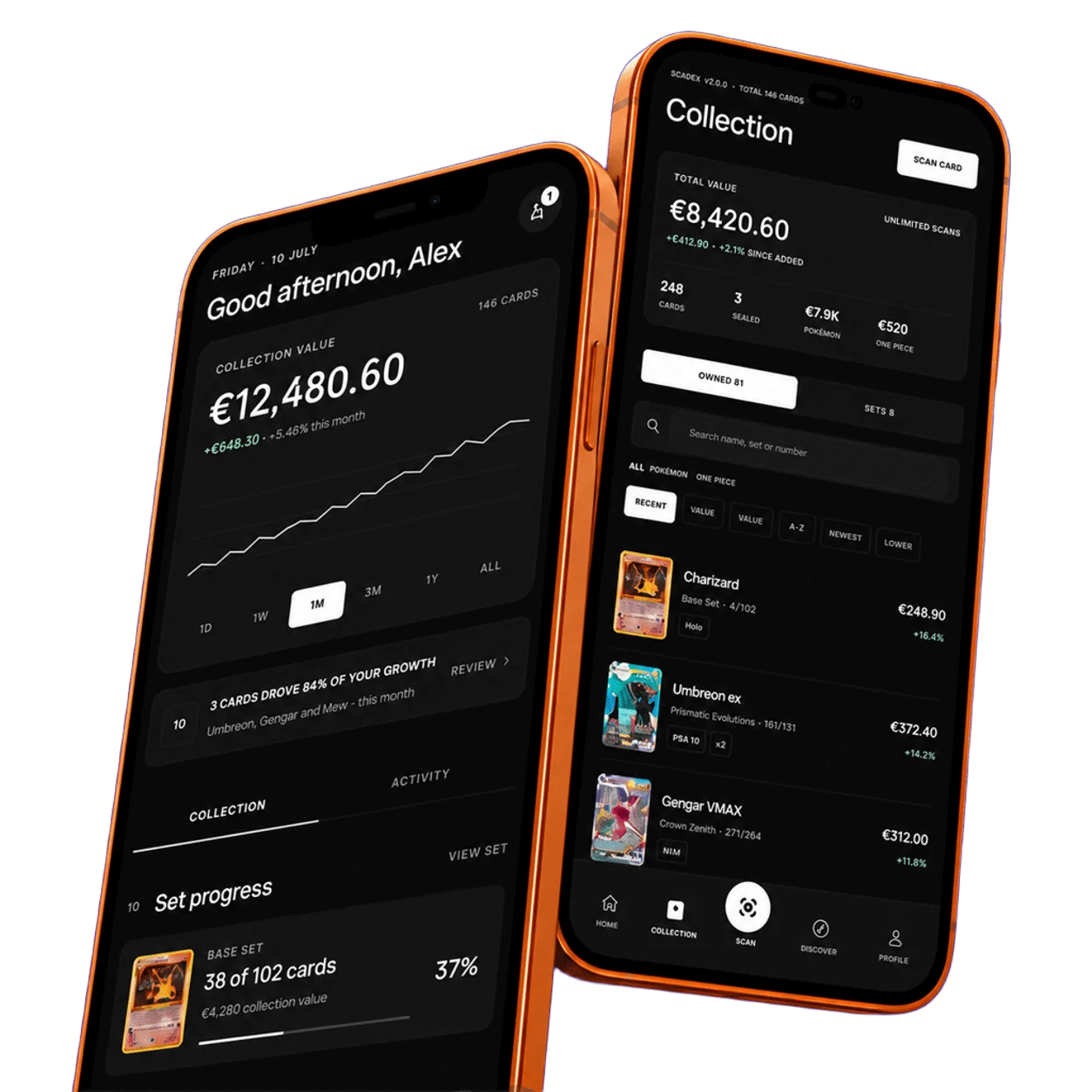
Scadex helps with one part of this: it shows the raw European price and graded comparison prices for PSA, BGS, CGC and SGC on the same screen, so you can see the spread before you start pricing postage. It has no view on customs, and it cannot judge your card's condition from a scan.
European grading questions
Sending cards abroad,
answered.
Do I pay customs and VAT when a graded card comes back to the EU?+
If the card travels outside the EU customs area and back, the return shipment is an import and can attract VAT and duty. There are customs procedures intended for goods returning after processing, but they have to be declared correctly at the point of export and are not applied automatically. Because the treatment depends on your country and on how the shipment is declared, check with your national customs authority or a customs agent before sending rather than after.
Is it cheaper to use a grader with a European facility?+
Often, yes, because a shipment that stays inside the EU customs area avoids import charges on the way back and the postage is shorter in both directions. Whether a given grader offers European intake, and where the cards are physically graded, changes over time, so confirm it on the grader's own site before assuming.
Which grader gets the highest resale price in Europe?+
It varies by game, era and grade rather than being fixed. The practical way to answer it for your card is to compare completed sales for the same card in each company's slab at the same grade, in euros, rather than relying on a general reputation ranking.
Should I use a European grading company instead?+
Europe-based graders can be cheaper and much faster because nothing crosses a customs border. The trade-off is liquidity: the largest international companies have the widest recognition among buyers, so a slab from a smaller grader may be harder to sell or fetch less. If you are grading to keep rather than to sell, that trade-off matters far less.
Does Scadex offer grading or submissions?+
No. Scadex is a scanner and collection tracker. It shows raw and graded market prices side by side so you can judge whether grading is worth it, and you record cards you already own as raw or graded. It does not grade cards, handle submissions or act as an intermediary.
Keep reading
Where to next.
Is it worth grading?
The break-even maths, and why the grade you expect changes everything.
Read the guide →Condition guide
Judge centring, corners, edges and surface before you spend anything.
Read the guide →How pricing works
Where graded comparison prices come from, and what they do not tell you.
Pricing methodology →Your collection starts here