
Grading guide
Is this card worth grading?
Most cards are not, and the maths is not complicated. It just needs the honest grade rather than the hoped-for one.


Updated August 2026
The short answer
Grading pays when the price of the card in a slab, at the grade you will realistically receive, exceeds the raw price plus every cost of getting it graded, by enough margin that a disappointing grade does not wipe you out.
That last clause is where most people go wrong. Graded prices are not evenly spaced. The jump from a 9 to a 10 is frequently larger than the jump from a 7 all the way to a 9, so a card that looks brilliant at the top grade can lose money one step down. If your calculation only works at a perfect grade, it is not a calculation, it is a bet.
The four numbers you need
Everything else is detail. Get these four and the decision usually makes itself.
1. The raw price
What the card sells for ungraded, on the market you would actually sell into. If you are in Europe that means a euro price from European sales, not a converted US figure. Use a trend or average price rather than the cheapest listing, because one optimistic seller is not a market.
2. The graded price at a realistic grade
Look up the slab price, then be honest about which grade you are looking up. If the card has a soft corner or is visibly off-centre, you are not getting a 10, and pricing it as though you are will produce a decision you regret. Look up the grade below the one you think you deserve and see whether the case still holds.
3. The total cost, not the headline fee
The grading fee is the advertised number and rarely the real one. Add shipping to the grader, return shipping, insurance on both legs, and — if you are sending outside your own customs area — import duty and VAT on the way back. For collectors in Europe sending to a US grader, those last items regularly cost more than the grading itself.
4. How long you can wait
Turnaround is a cost even though no one invoices you for it. A card away for several months is a card you cannot sell into a spike, and the market you calculated against may not be the market you return to.
A worked example
Suppose a card trades raw at €80. In a PSA 10 it sells for €400, and in a PSA 9 it sells for €120. Grading, shipping both ways, insurance and import charges come to €70 all in.
- At a 10: €400 minus the €80 you already had, minus €70 of cost, leaves €250 of upside. Excellent.
- At a 9: €120 minus €80 minus €70 leaves you €30 worse off than not bothering.
So the entire decision rests on one question: how confident are you of a 10? If the answer is anything short of very, the expected value is thin, and that is before you consider that you spent months waiting to find out. This shape — enormous at the top grade, negative one grade down — is extremely common on modern cards, and it is why "the spread is huge" is not on its own a reason to grade.
Which cards actually clear the bar
Two conditions have to hold at once, and either alone is a trap.
- A wide raw-to-slab spread. Grading a card whose slab price is barely above raw just converts money into cardboard and postage.
- A realistic shot at a high grade. A pack-fresh card handled with care from the moment it came out. Anything that has lived in a binder, been shuffled, or spent a decade in a shoebox is fighting uphill.
Beyond that, a few patterns come up repeatedly. Vintage cards in genuinely strong condition tend to reward grading because authentication carries real weight and high grades are scarce. Modern chase cards can work, but only from sealed product handled carefully, because the supply of pristine copies is large and the market prices accordingly. Bulk almost never works, no matter how clean it looks.
Judging your own card, honestly
Graders look at centring, corners, edges and surface. You can check all four yourself in a couple of minutes, and doing so is the highest-value thing you can do before spending money.
- Centring. Compare the border width on opposite sides under good light. Off-centre is the most common reason a card that looks flawless comes back at a 8 or 9.
- Corners. Look at all four under angled light, not straight on. Whitening shows up at an angle first.
- Edges. Run your eye along all four for nicks and white flecks, particularly on dark-bordered cards where they are unmissable to a grader.
- Surface. Tilt the card and look across it rather than into it. Print lines, scratches and dimples appear in reflection.
If any of those four is clearly imperfect, price your decision at a 9 or below and see whether it still makes sense. The condition guide covers each one in more detail.
Where Scadex fits
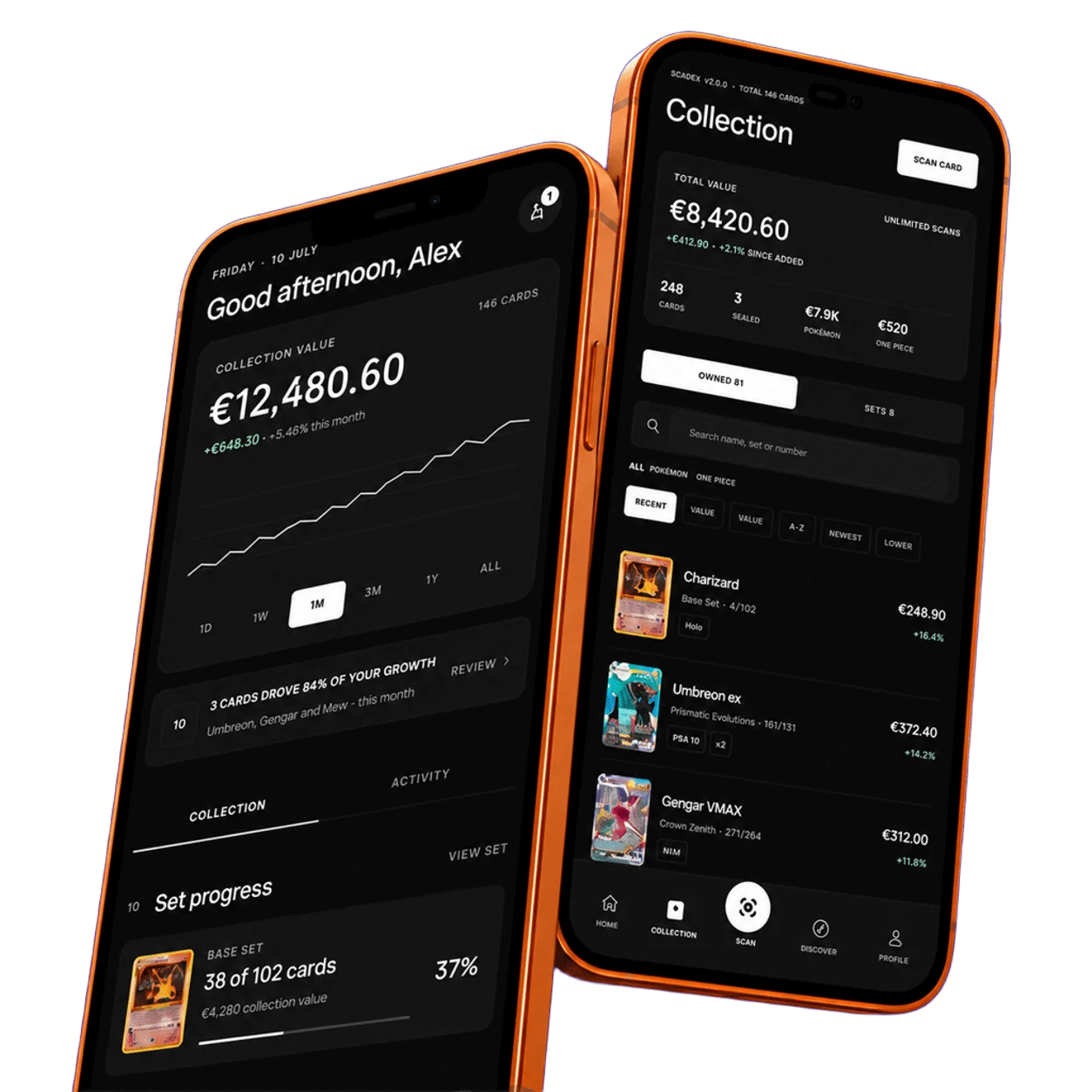
Scadex puts the raw European price next to graded comparison prices for PSA, BGS, CGC and SGC on the same screen, so the spread is visible without opening three tabs, and it flags cards where that spread is wide enough to be worth a second look. Both of those are free — they are not behind Pro.
What it cannot do is judge your copy. A camera scan identifies which card you are holding, not how well it has been kept, so the grade you would receive is a judgement only you can make with the card in your hands. Scadex also has no graded data for some special printings and does not show a graded ladder for Japanese cards, and in those cases it says so rather than filling the gap with a guess.
Grading questions
Grading decisions,
answered.
How do I know if a card is worth grading?+
Compare the graded price at a realistic grade against the raw price plus every cost of grading, including fees, shipping both ways, insurance and any import charges. If the gap does not comfortably exceed the cost, grading does not pay. Cards worth grading usually have both a wide raw-to-slab spread and a genuine chance of a high grade.
What is the minimum card value worth grading?+
There is no fixed threshold, because it depends on the grading fee and the size of the spread rather than the card's value alone. A useful test is whether the increase from slabbing is at least two to three times the total cost, which gives room for the grade to come back lower than you hoped.
Does Scadex tell me if a card is worth grading?+
Scadex shows the raw price next to graded comparison prices for PSA, BGS, CGC and SGC where that data exists, and flags cards where the spread is wide enough to be worth a look. That surfacing is free. It cannot judge the condition of your specific copy from a camera scan, so the grade you would actually receive is still your call.
Why does the grade I receive matter so much?+
Graded prices are not evenly spaced. The gap between a 9 and a 10 is often far larger than the gap between a 7 and a 9, so a card that pays handsomely at the top grade can lose money one grade down. Running the maths on the grade you will realistically get, rather than the one you are hoping for, is the single biggest correction most people need.
Is it worth grading a card I want to keep?+
That is a different question, and the maths above does not answer it. A slab protects the card, settles authenticity and makes condition legible to anyone who looks at it later. If those are what you want, the spread matters less — you are buying protection and certainty rather than a return.
Keep reading
Where to next.
Grading from Europe
PSA, CGC and BGS compared on the things that actually differ for European senders.
Read the guide →Condition guide
The European condition ladder from Mint to Poor, and how to place a card on it.
Read the guide →How pricing works
Where graded and raw prices come from, and the limits of each.
Pricing methodology →Your collection starts here