
Valuation guide
How much is your collection actually worth?
There are three honest answers to that question and they are very different numbers. Knowing which one you need is most of the work.


Three numbers
Which answer do you need?
Most arguments about collection value are really two people using different definitions. Pick yours before you start counting, because the gap between them is not small.
- Market total
The sum of what every card is currently worth on the open market. This is the number a tracking app shows you and the right one for following your collection over time. It is not money you have.
- Net sale proceeds
What would land in your account after marketplace fees, shipping, packaging and the discount you accept for selling quickly. Always lower than the market total, often by more than people expect.
- Replacement cost
What it would take to rebuild the collection today, including postage on many separate purchases. This is usually the highest of the three and the one insurers care about.
Updated August 2026
The mistake almost everyone makes
Pricing every card individually. It feels rigorous and it produces a wildly inflated number, for a simple reason: the cheapest listing on a common card is often a few cents, but nobody will buy one common card from you for a few cents, because the postage costs more than the card. A thousand commons priced individually might total a respectable sum on paper and sell for the price of a takeaway in practice.
Collections are almost always shaped the same way. A small number of cards carry the overwhelming majority of the value, and a large tail of commons and near-commons carries almost none. Recognising that shape early saves an enormous amount of time, because it tells you where to be careful and where not to bother.
A method that works
1. Split the collection in two
Go through and pull out anything plausibly worth more than a few euros: holos, rares, chase cards, anything from a set you know is sought after, anything vintage, and anything graded. Everything else is bulk. Do not agonise over borderline cards — if you are unsure, put it in the valuable pile and check it properly.
2. Price the valuable pile individually and precisely
Precision matters here in a way it does not elsewhere, and the thing to be precise about is which printing you have. The same character in the same set can exist as a common, a reverse holo, a full art and an alternate art at wildly different prices, and the difference is a small symbol and a card number rather than anything obvious. Get the printing wrong and the number is meaningless no matter how carefully you looked it up.
Use a trend or average price rather than the cheapest active listing, and if you are in Europe use euro prices from European sales rather than converting a US figure. Check condition against the condition ladder — quoted prices generally assume Near Mint, and a played copy of an expensive card can be worth a fraction of what you looked up.
3. Value the bulk by volume
Bulk trades by the hundred or thousand, not by the card. Look at what bulk lots for that game and era actually sell for and apply a rate. It will feel insultingly low compared to adding up individual prices, and it will be far closer to the truth.
4. Convert to the number you need
You now have a market total. If you want net proceeds, subtract marketplace fees, shipping and packaging, and then a discount for speed — selling a collection quickly always costs more than selling it patiently. If you want replacement cost, work upward instead, adding the postage you would pay buying these cards back one or two at a time.
Why the market total still matters
It would be easy to conclude the market total is a vanity figure. It is not, as long as you know what it is. It is the right number for tracking whether your collection is going up or down, for comparing one part of it against another, for insurance conversations, and for deciding what to sell. It is only misleading when it gets mistaken for cash.
What makes it genuinely useful is watching it over time rather than reading it once. A total that has drifted up for six months tells you something. A total you calculated once, two years ago, tells you nothing about today.
How Scadex does it
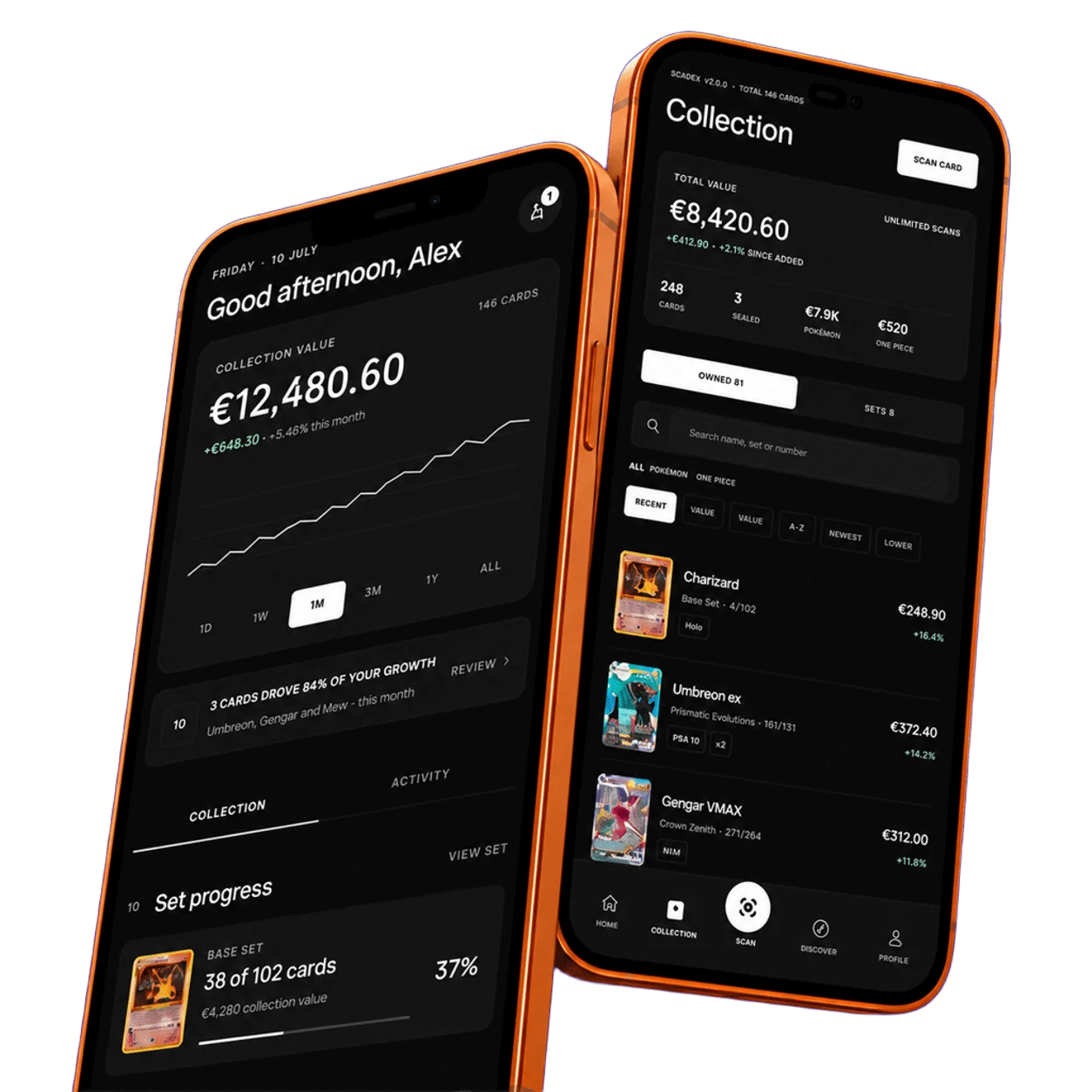
Scan a card and it goes into your collection with its European market price attached, and the total updates as the market moves rather than as you remember to check. Portfolio value and its history chart are free, as is set completion, so you can see the total and the shape of it without paying anything.
A few specifics worth knowing:
- CSV export is free. You get a card-by-card list out of the app, which is what you want for an insurance record or your own spreadsheet.
- Cards are recorded as raw or graded. There is no per-card raw condition field, so a Near Mint and a Played copy of the same card are both valued at the same raw price. On a collection with a lot of well-worn expensive cards, that will read high.
- Per-card profit since you added it is a Pro feature. The overall portfolio history is not.
- Bulk is still bulk. Scanning a thousand commons will produce a total built from individual market prices, which is exactly the overstatement described above. Scadex is most useful on the cards that carry the value.
What no app can tell you
A market price is not an appraisal of your specific card, and a collection total is not an offer. Condition, centring and print run all move the real number and none of them are visible to a camera. If you need a figure that will stand up formally — for probate, a legal matter, or a high-value insurance policy — you need an independent professional valuation, not a tracking app, however good the underlying data is.
Valuation questions
Collection value,
answered.
How do I find out how much my card collection is worth?+
Separate the small number of genuinely valuable cards from the bulk, price those individually at European market prices using the exact printing, and value the remainder at a bulk rate per hundred or thousand cards. Pricing every common card individually is the most common mistake and inflates the total enormously.
Is my collection worth what the app says?+
A collection total is the sum of market prices, which is what the cards are worth, not what you would receive for them. Selling involves marketplace fees, shipping, and either a discount for speed or a great deal of time listing individually. Treat the market total as a tracking figure and expect meaningfully less in hand.
Does condition change my collection value?+
Substantially, on the cards that matter. Quoted prices generally assume Near Mint, so a played copy of an expensive card can be worth a fraction of the figure you looked up. On bulk it makes little difference because bulk is priced by volume anyway.
Can I export my collection for insurance?+
Scadex includes CSV export at no cost, which gives you a card-by-card list with values that you can send to an insurer or keep as a record. Note that insurers generally want replacement cost rather than a market total, and may require independent valuation above a threshold.
How long does it take to value a big collection?+
Far less than people fear, if you split it first. The valuable pile in most collections is dozens of cards rather than thousands, and scanning those is quick. The bulk does not need pricing card by card at all, which is where the time would otherwise go.
Keep reading
Where to next.
Your collection starts here