Market data

What a card is worth, and how we know.

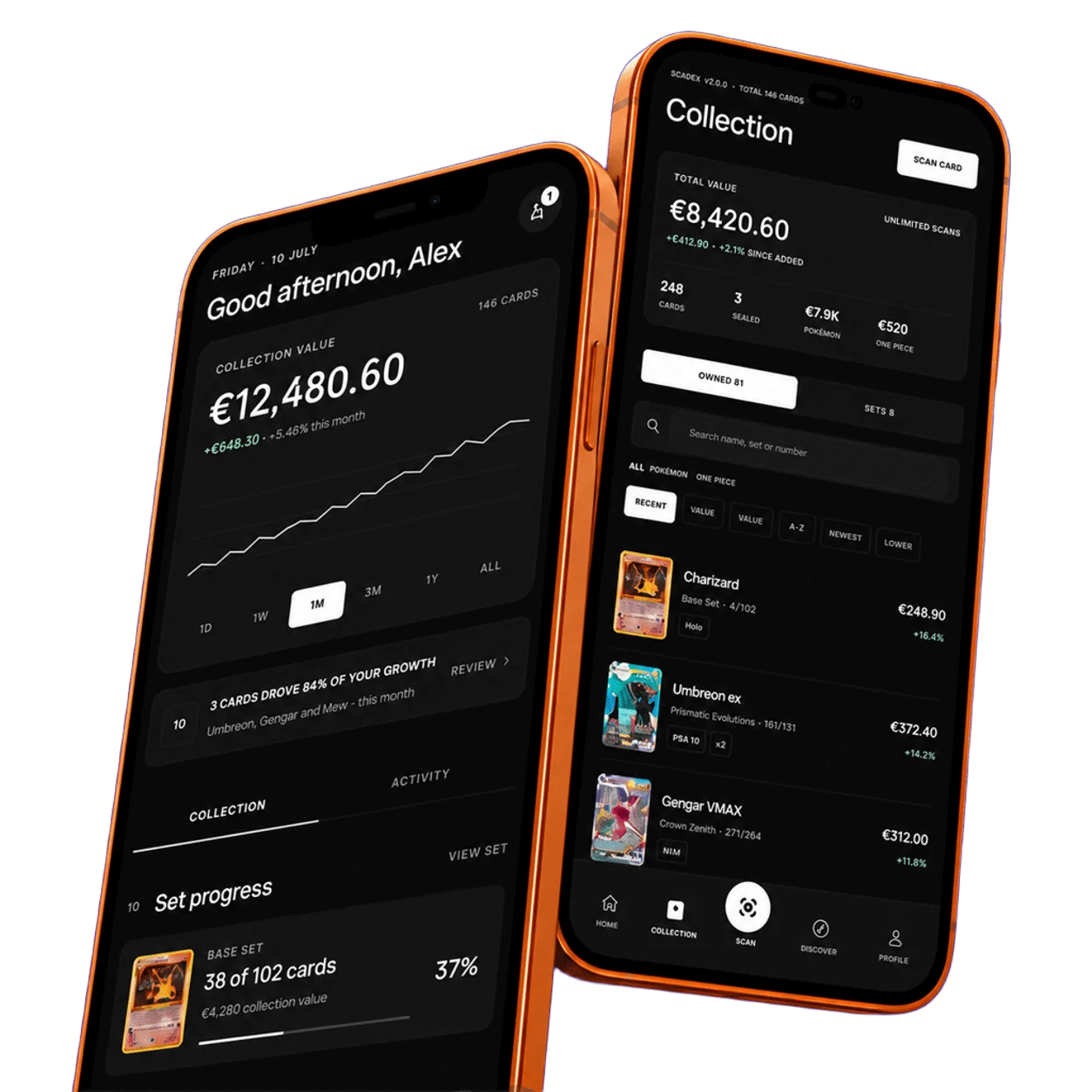
Scadex prices cards on European market data, in euros, and shows you enough around the number to judge whether to trust it.

Get it on Google PlayDownload on the App Store
Card Prices and Market Data in Scadex

Sources

Where the numbers come from.

Most card pricing tools are built around the US market and convert to euros at the end, which produces figures nobody in Europe is actually paying. Scadex starts from European data instead. Here is exactly what feeds what.

Beyond the headline

One number is not enough.

A single price tells you very little on its own. Two cards can show the same figure while one sells every day and the other has not moved in a month. These are the signals Scadex puts next to the number.

Price by condition

Mint down to Poor.

The live Cardmarket ladder for the card in front of you: what copies are listed at in Mint, Near Mint, Excellent, Good, Light Played, Played and Poor. It is market listing data, so it tells you what a condition is going for rather than valuing your particular copy. Cards in your own collection are tracked as raw or graded.

Seven condition stepsMint → PoorLive listing prices, not estimates
⌁

How often it sellsPro

Sells most days, regularly, occasionally, or not at all in the last 30 — with sale-day counts, the last sale price and how many sellers are listed.

↗

Price history

A sparkline and rolling averages on every card. Pro adds the full scrubbable chart across 1D, 7D, 30D and max, plus longer ranges on sealed product.

◇

Graded comparisons

See the gap between a raw copy and PSA, BGS, CGC or SGC slabs, and which cards have a spread wide enough to make grading worth a look.

◎

PulsePro

Cards whose European price is climbing and whose sales are speeding up. Pulse describes movement, not future value.

Updated August 2026

Honest limits

What a market price is not

Scadex is more useful when it is clear about the edges of what it knows, so these are worth reading before you lean on a number.

It is not an appraisal of your card

A market price reflects what comparable copies are listed and sold for. Your specific copy has its own condition, centring and print run, and none of that is visible to a scanner. Treat the figure as the market's opinion of the card, not a valuation of the object in your hand.

It is not investment advice

Prices move, sometimes sharply, and past movement does not tell you where a card goes next. Scadex shows sale frequency and history precisely so that a single number never has to carry all the weight of a decision.

Thin markets say so

When there is not enough activity behind a card to price it confidently, Scadex says the market data is limited rather than inventing precision. A price on a card that sells twice a year deserves far less confidence than one that sells daily.

Some printings have no European price

Cardmarket is a European marketplace, so Japanese, Korean and Chinese printings are not priced in euros there. Rather than converting a figure from another market and presenting it as European, Scadex tells you it has no reliable price for that printing.

Currency conversion is display only

You can view your collection in pounds, zloty, krona, francs, yen and others. Those are converted daily from the underlying euro and dollar market prices — the pricing itself does not change, only how it is shown.


Pricing questions

How pricing works,
answered.

Where do Scadex card prices come from?+

European prices come from Cardmarket, shown in euros, using the trend price as the headline figure alongside 1-day, 7-day and 30-day averages. Graded comparisons come from a separate dataset covering PSA, BGS, CGC and SGC slabs, and a small number of cards fall back to an estimate from another market where European coverage does not exist yet. Estimates are labelled as estimates.

Are Scadex prices in euros?+

Yes. Scadex is built around European market data rather than converting US prices at the end, so the euro figure reflects what cards trade for in Europe. You can switch the display currency to pounds, zloty, krona and others, which converts daily from the underlying EUR and USD market prices.

Can I see what a card sells for in each condition?+

Yes, with Scadex Pro. The condition ladder shows live Cardmarket listing prices from Mint down through Near Mint, Excellent, Good, Light Played, Played and Poor. It reflects what copies in each condition are listed at, and is separate from how you record your own copies, which are tracked as raw or graded.

How do I know whether a price is reliable?+

Scadex Pro shows how often a card actually sells rather than only what it is listed at: selling most days, regularly, occasionally, or no recorded sales in the last 30 days, along with sale-day counts, the last sale price and how many copies and sellers are listed. A price on a card that rarely sells carries much less weight than the same price on one that sells daily.

Does Scadex show graded card prices?+

Yes, where the data exists. Scadex shows comparison prices across PSA, BGS, CGC and SGC grades so you can see the gap between a raw copy and a slab, and flags cards where that gap suggests grading may be worth considering. Cards you own can be recorded as graded and are then valued at the grade you entered.

Is a Scadex price an appraisal of my card?+

No. A market price reflects what comparable copies are listed and sold for. It is not an appraisal of your specific card and it is not investment advice. Condition, centring, print run and grading all move the real number, which is why Scadex shows sale frequency and price history next to the figure.

Keep reading

Where to next.

See it on your own cards

Scan one and look.