Scan a tricky card
Pick one that exists in several printings and check the app returns the exact set and card number, not just the character.
 Get Scadex
Buyer's guide
Every one of them claims fast, accurate scanning. The differences that matter are elsewhere, and one of them will cost you a weekend if you get it wrong.


Updated August 2026
Every scanner app will recognise a card. The question is how precisely. Recognising that you are holding a particular character is easy and almost useless, because that character may exist as a common, a reverse holo, a full art and an alternate art across several sets, at prices ranging from a few cents to several hundred euros.
What you actually need is identification down to the printing: the right set, the right card number, the right treatment. Test this before you commit. Scan a card that exists in multiple printings and check whether the app returns the exact one in your hand or something merely plausible. An app that is fast and wrong will quietly fill your collection with prices that belong to other cards.
This is the criterion most people never think about and most regret ignoring. Card prices are not global. The same card trades at genuinely different levels in Europe, the United States and Japan, driven by different supply and different buyers.
An app built around US marketplace data can convert its figures into euros, and the result will look like a European price while being nothing of the kind. If you buy and sell in Europe, you want prices sourced from European sales in euros. If you trade in the US, the reverse applies. Check what the source actually is rather than which currency symbol it can display.
A single price is easy to show and easy to misread. Two cards displaying €40 are not equivalent if one sells several times a week and the other has not sold in two months — the second figure is an asking price with nobody behind it.
So look for what the app puts next to the headline: whether prices are broken down by condition, whether you can see how often the card actually sells rather than how many are listed, whether there is price history rather than a snapshot, and whether graded prices are shown separately from raw ones instead of blended into an average.
Scanning one card is a demo. Scanning six hundred is the actual job. Ask whether the app can identify several cards in one camera frame, how quickly you can confirm and save a match, and whether the flow assumes you will stop to admire each card. The gap between apps here is enormous and it is invisible until you sit down with a real stack.
Catalogue three thousand cards and you have created something valuable that lives inside someone else's app. Two questions follow, and both are worth answering before you start rather than after.
Can you export your collection to CSV, and is that export free or behind the subscription? And if you cancel, does your collection stay readable or does it lock? An app that holds your catalogue hostage has a great deal of leverage over you at renewal time.
Free tiers vary from generous to decorative. What matters is not whether there is a free tier but where the line falls: some apps limit how many cards you can own, others limit how many scans you get, others give you everything but hold back the market detail. Work out which limit you will hit first, because that is the one that will decide whether you pay.
Since we are asking you to apply these criteria, it is only fair to apply them to ourselves.
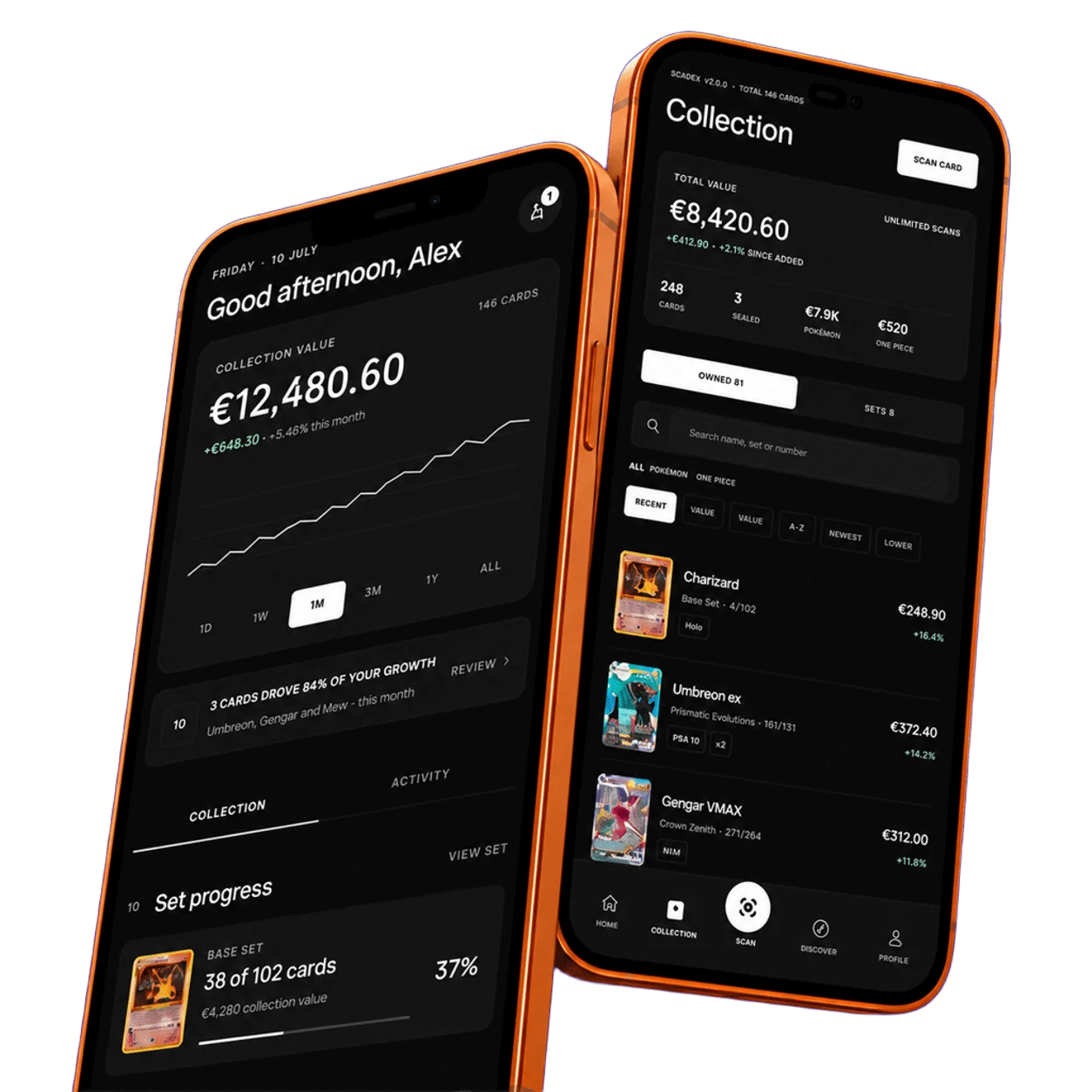
Scadex suits you if you collect Pokémon, One Piece, Lorcana or Dragon Ball and you trade in Europe. Prices are euro figures from European market data rather than converted dollars, identification works down to the printing and card number, and the free tier includes the things people most often expect to pay for: collection tracking, portfolio value and its history, set completion progress, sealed product, and CSV export. The market depth — condition ladders, how often a card sells, the full price chart, multi-card scanning — is what Pro is for.
Genuinely, in these cases you should use something else.
None of that is likely to change tomorrow, so it is better said here than discovered after you have scanned a thousand cards.
The checklist
Fifteen minutes with a trial and a handful of cards will tell you more than any review.
Pick one that exists in several printings and check the app returns the exact set and card number, not just the character.
Find out which marketplace the figures come from and whether the currency is native or converted.
Time it. The per-card friction that is charming once becomes unbearable at volume.
Before cataloguing anything serious, confirm you can get a CSV out and whether it costs extra.
Common questions
Whether it identifies the exact printing rather than just the character, which market its prices come from and in which currency, whether it shows anything beyond a single headline number, whether you can export your collection, and what happens when you stop paying. Identification accuracy at printing level matters most, because a price attached to the wrong printing is worse than no price.
Usually because they source from different marketplaces. An app built around US data will show a converted dollar figure, while one built around European data shows a euro figure from European sales. Neither is wrong, but only one reflects the market you would actually buy or sell in.
No. Scadex is built around European market prices in euros, so collectors trading primarily in the US market are better served elsewhere. It also has no deck builder, no marketplace, no web version, and it records owned cards as raw or graded rather than storing a raw condition per copy, which matters if you are running a resale inventory.
In Scadex, yes — CSV export is free rather than a paid feature. This is worth checking in any app before you catalogue thousands of cards, because a collection you cannot export is a collection you cannot move.
Because we would not be able to keep it honest. Competitor features and prices change constantly, and a table maintained by a competitor is a table with a thumb on the scale. The criteria above let you build your own comparison against whatever the apps actually do today.
Keep reading
Your collection starts here